
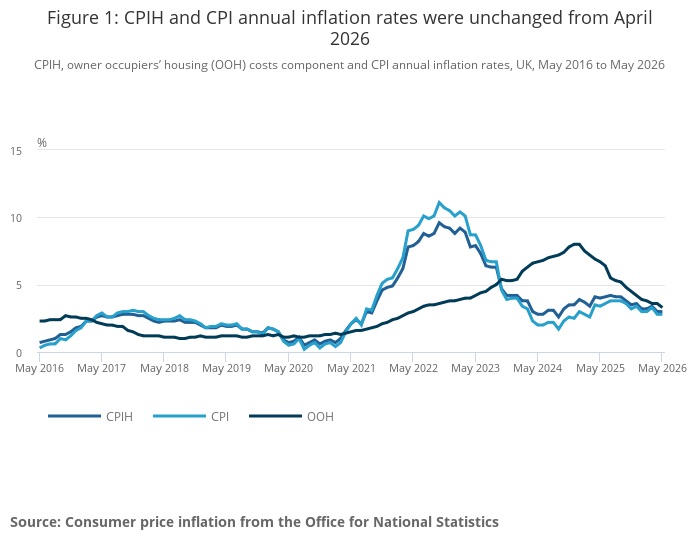
CPI inflation remained level in May at 2.8%, the same as April, despite predictions of a rise amid a backdrop of global uncertainty.
Latest figures from the Office for National Statistics suggest inflation was under control last month.
The picture ahead is less certain.
The Consumer Prices Index (CPI) rose 2.8% in the 12 months to May, unchanged from the 12 months to April. On a monthly basis, CPI rose by 0.2% in May 2026, the same rate as in May 2025.
The wider Consumer Prices Index, including owner occupiers' housing costs (CPIH), rose 3% in the 12 months to May, unchanged from the 12 months to April. On a monthly basis, CPIH rose by 0.2% in May 2026, the same rate as in May 2025.
ONS said that transport costs made the largest upward contribution to the monthly change in CPIH and CPI annual rates. Food and non-alcoholic drinks were the largest downward contribution to prices, partially offsetting the increase.
Core CPIH (CPIH excluding energy, food, alcohol and tobacco) rose 2.8% in the 12 months to May 2026, unchanged from the 12 months to April. The CPIH goods annual rate slowed from 2.4% to 2.0%, while the CPIH services annual rate rose from 3.4% to 3.6%.
Core CPI (CPI excluding energy, food, alcohol and tobacco) rose 2.6% in the 12 months to May 2026, up from 2.5% in the 12 months to April. The CPI goods annual rate slowed from 2.4% to 2.0%, while the CPI services annual rate rose from 3.2% to 3.7%.
The older measure of inflation, the RPI 12 month rate, increased from 3% to 3.1%.
Industry experts welcomed the news of no increase in inflation but were cautious on the future outlook, with the Bank of England set to announce its rate review tomorrow.
Luke Bartholomew, deputy chief economist, at Aberdeen said: “With inflation coming in softer than expected again, the pressure on the Bank of England to hike rates this year will continue to fade, although there may still be a couple of policymakers who vote for a rate increase tomorrow.
"Despite energy prices having fallen recently, there is more inflationary pressure to come for the UK, when the Ofgem price cap moves higher next month. So, the Bank will still want to remain vigilant to the impact of higher household energy bills on broader inflation expectations. But with the economy otherwise relatively weak, it is plausible speculation begins to turn once again to when the Bank will cut rates again, not hike.”
Scott Gardner, investment strategist at JP Morgan Personal Investing, said: “UK inflation was flat during May, coming in below expectations despite higher energy prices continuing to weigh on UK households and businesses. This reading will provide some hope that any rebound in UK inflation could be short-lived after the announcement of a framework deal earlier in the week between the White House and Iran to stop fighting."
Kevin Brown, savings expert at financial mutual Scottish Friendly, said: “The data suggests the recent energy shock hasn’t fed through as forcefully as feared, giving the Bank of England more room to look through immediate inflationary pressure from the Iran conflict.
“At tomorrow’s meeting, the Bank will likely still need to tread carefully. The economy contracted in April, hiring intentions remain weak and households are highly price sensitive, so raising rates could add pressure while lacking the power to lower global energy prices."