
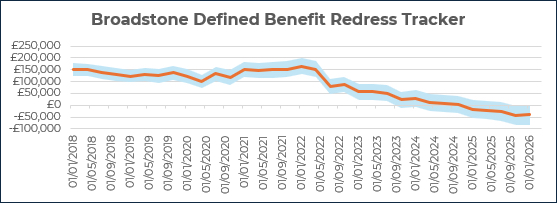
The years of huge compensation payouts for pension transfer redress look to be easing after the latest Broadstone DB Redress Tracker revealed DB pension transfer compensation remained nil in the majority of cases in 2025.
The year marked a “radical decline” in potential redress, the firm said, with typical consumers reckoned to be better off as a result of most pension transfers.
That’s a marked difference to 2022 when the average compensation was higher than £150,000.
But it doesn’t mean that redress payments are a thing of the past, Broadstone said, urging Financial Planning firms to review historic transfer business.
The DB Redress Tracker follows the example of an individual who left their scheme in 2018 aged 50, with a pension of £10,000 pa, which would receive inflation-linked increases when in payment.
The Tracker was developed in line with FCA rules for calculating redress with the individual assumed to have invested their funds to earn returns in line with the FTSE Private Investor Index.
The latest update shows that the central estimate of compensation for a typical pension transfer redress case rose slightly from -£44,000 to -£41,000 between Q4 2025 and Q1 2026. That means the example consumer has been calculated to be better off as a result of the transfer.
Before 2025, redress was typically payable in pension transfer cases, however, that dropped through 2025 such that most cases now result in a conclusion of no loss. Redress fell by approximately £25,000 from around -£16,000 in Q1 2025 to around -£41,000 in Q1 2026.
Compensation has seen a radical decline in the last four years - after peaking at £165,000 in Q1 2022, it has fallen by more than £200,000 to -£41,000.
Simon Robinson, senior consultant and actuary at Broadstone, said: “The average level of DB transfer redress remains historically low and means that most cases will still show ‘no loss’ at the beginning of 2026.
“Despite this, we are still seeing many cases where compensation is due. A high critical yield at the time of transfer is often a warning sign that a claim will arise and redress become payable.
“Firms should review their historic transfer business to identify any cases of particular concern.”