

Mergers and acquisitions in the wealth management sector have tripled over the past six years but appear to be failing, so far, to boost revenue per adviser, according to new research.
The annual number of M&A transactions in the wealth management space averaged 154 in 2021–2025 compared with 50 in 2019–2020.
However, despite the M&A boom, there has so far been little sign of revenue per adviser rising and in many cases it fell.
M&A consultancy Dyer Baade & Company's analysis of data published by the Financial Conduct Authority found that consolidation has changed the structure of the advice market more than its performance. It found that while the number of advice firms fell from 5,236 in 2019 to 4,340 in 2024, adviser jobs rose from 27,557 to 28,245, increasing the average number of adviser posts per firm by 23.7%. Over the same period, however, revenue per adviser, after allowing for inflation, was 6.3% lower.
M&A Wealth Management sector deals
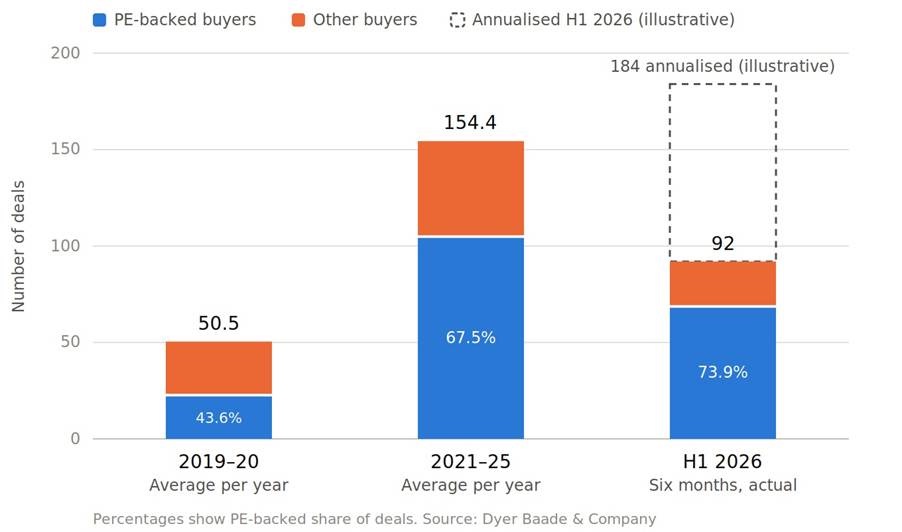
Source: Dyer Baade & Company
Daniel Baade, CEO of Dyer Baade & Company, said: “Deal activity in wealth management has reached a level that would have been hard to imagine five or six years ago, and private equity is firmly in the driving seat. But the volume of deals tells only part of the story.
“The vast majority of transactions are bolt-ons rather than deals that create entirely new platforms, and while consolidation has put more advisers into fewer firms, that hasn't yet translated into higher revenue per adviser.
“For owners, the message is that scale is valuable, but it isn't the whole story. Buyers pay a premium for quality, and the strongest independent firms often have capabilities that much larger groups still need. Anyone considering a sale should understand where a buyer is in its ownership cycle and ask for evidence that past acquisitions have delivered what was promised.”
{loadpostion hidden2}
The study found that private equity investment has been the main driver of the M&A activity. In the first half of this year, 92 deals were recorded, suggesting the elevated level of activity has continued, according to the firm. Private equity-backed buyers were involved in nearly three-quarters of the transactions recorded in H1 2026.
The firm’s report, ‘The Next Phase of Wealth Management Consolidation’, found that the PE-backed share of transactions has risen steadily, from 43.6% in 2019–2020 to 67.5% in 2021–2025.
Most (95%) of deals were additions to established businesses. Only around one in 20 created a new ‘platform’, which is when a PE firm buys a company large enough to make its own acquisitions.
PE-backed businesses now make up 12 of the 20 largest firms in Dyer Baade's ranking, compared with five in 2016. However, together they hold only around 28% of those firms' combined assets, with the remaining eight firms holding most of the assets.
The research's overall median valuation is 7.8x EBITDA, excluding outliers, and has remained stable over the past five years. Approximate segment medians range from 7.0x for firms with up to £500m of client assets to 13.2x for those with more than £2bn.
PE-backed acquisition activity tends to follow a pattern with buyers completing an average of 1.98 acquisitions in their first year, rising to 2.50 in year two and 2.68 in year three, before falling to 1.72 in year five as integration and demonstrating operating results take a greater share of management attention.
The median completed ownership period in the sample was 4.82 years, with the middle half lying between 4.28 and 6.52 years.
• The report combined Dyer Baade & Company's proprietary UK Wealth Management M&A research with regulatory, company and public market data.